Heat Not Working? What to Check Before You Call
Heat pump or furnace not heating? Here are the safe checks to run first, what aux heat and defrost mean, and when to stop and call.
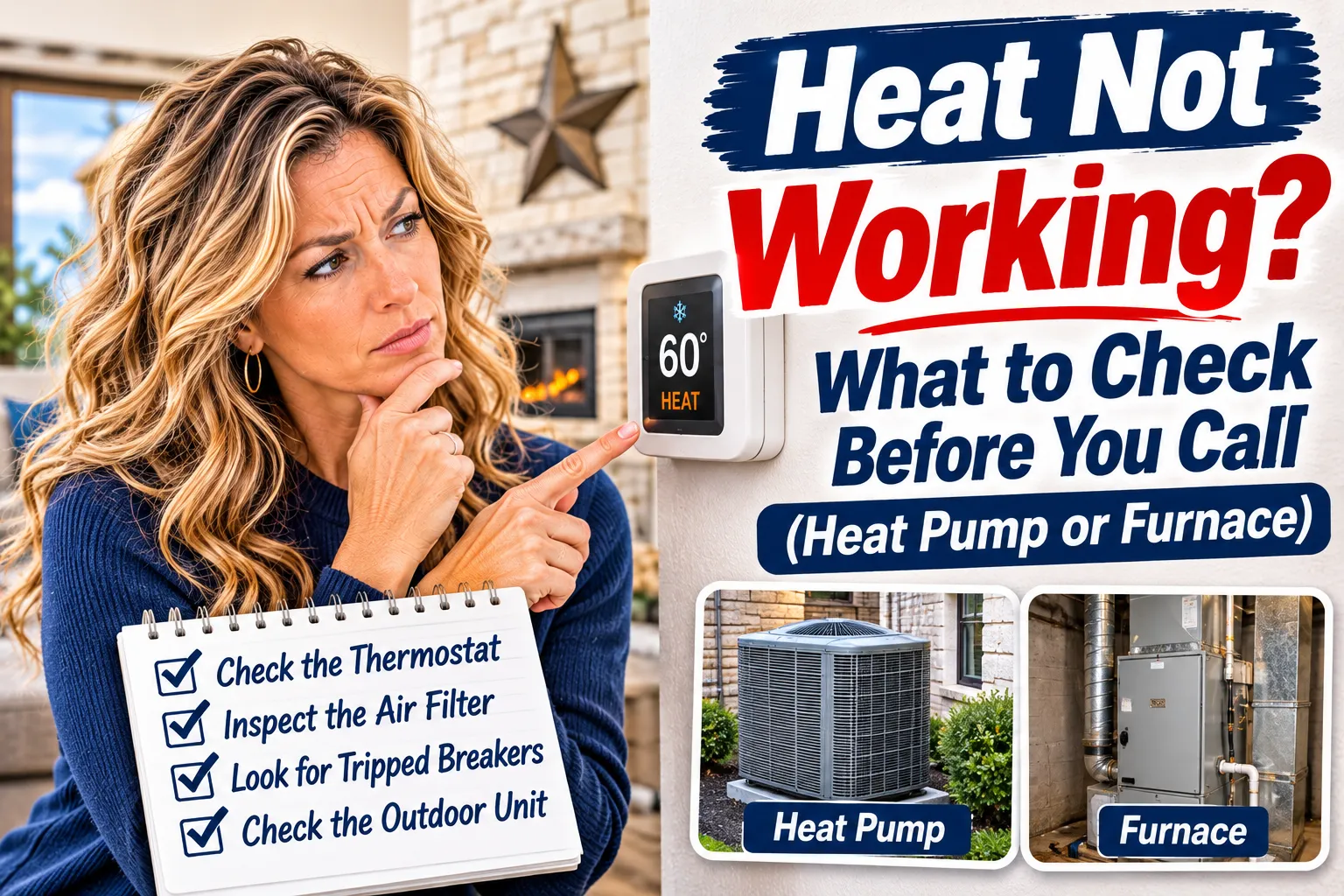
If your heat isn't working, check four things first. Make sure the thermostat is set to Heat and a few degrees above the room temperature. Make sure the breaker and the switch at your indoor unit are on. Check that the air filter isn't clogged. Make sure your vents are open. If all four look fine, stop there and call us. Anything past this point involves electrical or gas parts that are not safe to work on yourself.
First, which kind of heat do you have?
Most homes around Lago Vista and Jonestown heat with either a heat pump or a furnace. A heat pump is the outdoor unit that cools your home in summer and heats it in winter. A furnace burns natural gas or propane inside the house.
Here is an easy way to tell. On a cold morning, if the outdoor unit is running while the house warms up, you have a heat pump. If the outdoor unit sits quiet, you have a furnace. Many Lake Travis homes are not on a natural gas line, so propane tanks and heat pumps are both common out here.
What should I check first, whatever kind of heat I have?
These five checks work for both. They take about ten minutes.
Thermostat. Set it to Heat (not Cool or Off) and raise it about five degrees above the room temperature. If the screen is blank, replace the batteries.
Breaker. Find the breakers for your indoor unit, and for your outdoor unit if you have a heat pump. If one is tripped, switch it fully off and back on one time. If it trips again, leave it off and call us.
Unit switch. Many furnaces and air handlers have a plain wall switch near the unit that looks like a light switch. It gets bumped off more often than you would think.
Air filter. A clogged filter starves the system of air. A furnace will shut itself off to protect itself, and a heat pump can ice up.
Vents. Make sure the supply vents and the return grille are open and not blocked by furniture, rugs or boxes.
My heat pump is running, but the air feels barely warm. Is it broken?
Not necessarily. Heat pump air feels milder than furnace air because it is warmed less, but the system runs longer to make up for it. If your home holds its temperature, the heat pump is doing its job.
Two things people often mistake for a problem:
Aux heat. This is the backup electric heat in your indoor unit. It normally comes on during a cold snap, or when you raise the thermostat a lot at once. That is normal. It becomes a concern if it stays on for days and the heat pump outside is not running.
Defrost mode. On cold, damp mornings the outdoor unit can pause heating for a few minutes, give off steam, and send cooler air inside while it melts frost. That cycle is normal.
Emergency Heat is a different setting. It runs only the backup heat, which costs more to run, so leave it off unless a technician tells you to use it.
Take a look at the outdoor unit too. Clear leaves, pine needles and debris from around it, and keep a few feet of open space so air can move. If it is covered in thick ice, or the fan is not spinning at all, turn the system off at the thermostat and call.
My gas or propane furnace won't come on. What's safe to check?
After the five checks above, listen to what the furnace does. If the blower starts and then nothing warms up, or the furnace clicks and shuts off, that points to the ignition or a safety switch. That needs a technician.
If you have propane, look at the tank gauge before anything else. An empty tank looks exactly like a broken furnace. If you are on natural gas, see whether another gas appliance, like the stove or water heater, still works. If none of them do, the problem may be the gas supply and not the furnace.
What should I never do?
Do not relight a pilot or open the furnace panels yourself.
Do not bypass a safety switch or keep resetting a tripped breaker.
Do not heat the house with an oven or gas stove.
If you smell gas, do not flip switches or use your phone inside. Leave the house right away and call your gas provider or 911 from outside.
When should I call?
Call us if the basic checks don't fix it, if a breaker keeps tripping, if you hear grinding or banging, if the outdoor unit is frozen solid or silent, or if the house is not holding its temperature. If you ever smell gas, leave first and call from outside.
You can reach us at (512) 662-2949, Monday through Friday from 7:30 a.m. to 8 p.m. and Saturday from 8 a.m. to noon. A service visit starts with a $65 trip charge, and it is credited toward the work if you go ahead with the repair. We look at the problem, explain what we find in plain words, and give you the options before anything starts.
Want to know how those visits work? See our heating repair page, or our heat pump repair page if you have a heat pump. To catch problems before the first cold snap, a yearly heating visit is included with Real Home Care.
Frequently Asked Questions
Why is my heat pump blowing cold air?
It may be in defrost mode, which is normal and lasts a few minutes. If the air stays cool and your thermostat is set to Heat, check the filter and the outdoor unit, then call us.
Is it normal for aux heat to come on?
Yes, during cold weather or when you raise the temperature a lot at once. It is a concern only if it runs for days and the outdoor heat pump is not running.
My thermostat screen is blank. What should I do?
Replace the batteries first. If it still has no display, check the breaker and the unit switch. A blank screen often means the system has lost power.
How often should I change the air filter?
Check it once a month during heating season. Replace it when it looks gray or you can no longer see light through it.
How much does a service call cost?
Our trip charge is $65, and it is credited toward the repair if you move forward with the work.