How to Find and Shut Off Your Main Water Valve
Learn to locate and shut off your main water valve to prevent water damage in emergencies. Follow our comprehensive guide now.
Updated: Nov 3, 2026 · Efrain Realzola
Licensed & insured · Texas Responsible Master Plumber RMP44420 · TDLR AC Contractor TACLA22663C · Family-owned since 2018 · 2024 and 2026 Nextdoor Fave
Where is my main water shut-off valve?
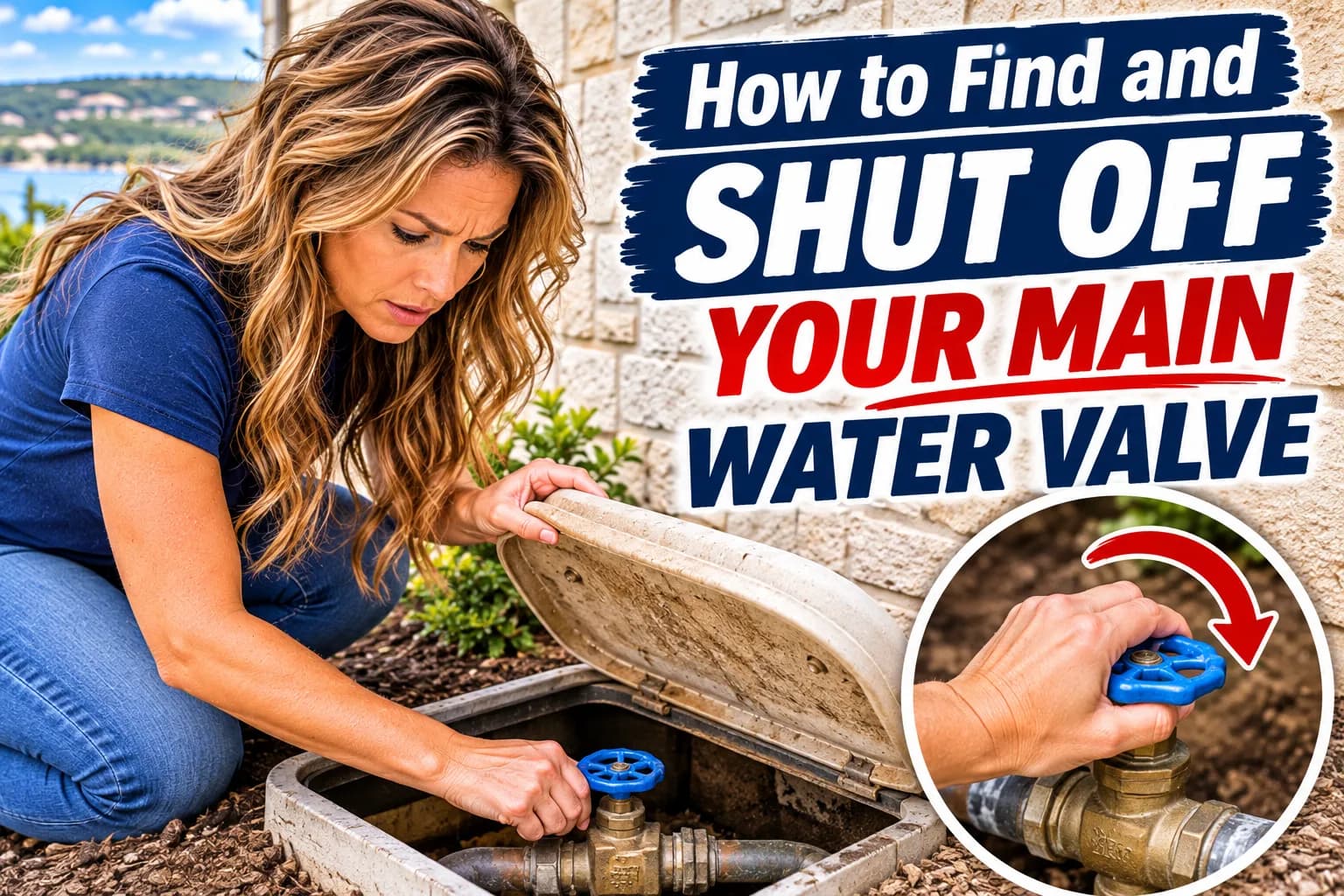
Your main shut-off valve is where the water line comes into your house, or in a box at the water meter near the street. If your house is on a slab, check near the water heater, in the garage, and at the meter box in your front yard.
To shut it off, turn a round wheel handle clockwise until it stops. If it has a lever handle, turn it a quarter turn so the lever sits crossways to the pipe.
The best time to find it is before you need it. A burst pipe, a failed supply line or a gushing toilet won't wait while you search the house. Ten minutes today can save you a flooded floor later.
This guide is from the family-owned team at Real Texas Plumbing in Lago Vista. It covers where to look, how to shut the water off safely, what to do next, and when to call us.
Why every homeowner should know where it is
The main valve controls all the water coming into your home. Closing it is the fastest way to stop a leak you can't otherwise stop.
You'll want it in these situations:
A burst or frozen pipe. Texas winters don't freeze often, but when they do, pipes split. See our guide to burst and frozen pipe repair.
A leak you can't find or reach, such as water coming through a ceiling or a wet spot in the wall.
A failed supply line or fixture, like a toilet, faucet or washing machine hose that won't stop.
A leaking water heater tank. Shut off the water, then call us. Here's our water heater repair page.
A plumbing repair or remodel, when your plumber needs the water off.
Leaving for a long trip, especially in winter.
If you're trying to track down a hidden leak, our guide on how to find a hidden water leak starts with a meter test that uses this valve.
Where to find your main shut-off valve
Builders put the valve in different places, so check each of these in order.
Inside the house
Near the water heater. In a slab home, the valve is often near the water heater, sometimes behind an access panel in a utility closet.
In the garage, on the wall where the water line enters the house, or near irrigation connections.
Under a kitchen sink or in a laundry room, on the wall closest to the street.
On an exterior wall, at the point where the pipe comes out of the ground.
Start on the side of the house that faces the street. The water line usually comes in from the same direction as the meter.
Outside, at the water meter
If you can't find a valve at the house, look for the meter box. It's a concrete or plastic box set into the ground near the front curb, with a lid that sits flush with the grass. In a slab home, the valve is often near the meter box in the yard, a couple of feet toward the house from the meter.
A few things to know about the meter box:
The lid may need a long screwdriver or a meter key to open. A meter key is a long-handled tool sold at hardware stores.
Look before you reach. Insects, spiders and snakes like these boxes. Use a stick or a flashlight first.
The meter belongs to your water utility. The valve on the utility's side of the meter isn't yours to turn. If you can only reach the utility's valve, call your water provider.
Don't mistake it for the pressure regulator
A pressure regulator is a bell-shaped brass fitting that often sits close to the main valve. It isn't a shut-off. Don't adjust it. If your water pressure seems too high or too low, call a plumber.
How to shut off your main water valve
Which way do I turn it?
Clockwise closes it. Counterclockwise opens it. Which valve you have decides how far you turn.
Ball valve (a lever handle). The lever is in line with the pipe when the valve is open. Turn it a quarter turn clockwise until it sits crossways to the pipe. It should move with firm hand pressure. Newer homes usually have this kind.
Gate valve (a round wheel handle). Turn the wheel clockwise several full turns until it stops. Gate valves can get stiff when they haven't been turned in years.
Step by step
Find the valve and clear anything in front of it.
Turn it clockwise to close it.
Open a faucet at the lowest point in the house, such as an outdoor spigot or a ground-floor tub. The water should slow to a trickle, then stop. If it keeps running, the valve isn't fully closed.
Open a faucet or two upstairs to let air in and drain the lines.
If the valve won't turn
Don't force it. Don't use a wrench or a pipe on the handle. A seized gate valve can snap its stem, and then you may have no working shut-off at all.
Try a gentle back-and-forth movement. If it still won't budge, shut the water off at the meter if you can reach your side of it, or call your water utility. Then call a plumber. A valve that won't close is a valve that needs replacing.
What to do after the water is off
Shutting off the water stops new water coming in. These steps handle everything else.
Turn off the water heater. For gas, turn the gas control to off or pilot. For electric, switch off its breaker. This protects the heater while the lines are empty.
Drain the lines. Open faucets, cold first. Flush a toilet once to clear the tank. This relieves pressure and limits how much water leaks from the break.
Protect your electrical. If water is near outlets, a panel or appliances, turn off power to that area, but only if you can reach the breaker without standing in water. If you can't, stay out and call us.
Contain the water. Move rugs and furniture, put a bucket under drips, and mop up what you can.
Take photos of the damage for your records, in case you file an insurance claim.
Call a plumber. Tell us where the water was coming from and what you've done.
Turning the water back on
Don't turn it on until the leak is repaired. When it's time:
Leave one cold faucet open on the lowest floor.
Open the main valve slowly.
Close the faucet once the water runs steady.
Check under sinks, around the water heater and along any exposed pipes for leaks.
Open the other faucets one at a time to clear air from the lines.
Turn the water heater back on last, once the tank is full.
If anything looks or sounds wrong, shut the water back off and call a plumber.
What not to do, and when to call
Mistakes to avoid
Don't force a stuck valve. A broken valve is a bigger problem than the one you started with.
Don't use a wrench on the pressure regulator or other fittings near the valve.
Don't touch the utility's side of the meter. That valve is the water provider's.
Don't turn the water heater back on before the tank is full.
Don't wait. Water spreads fast, so shut it off first and diagnose second.
Do I need to shut off the main for a grinder pump alarm?
Usually not. A grinder pump alarm means the tank is full. The fix is to stop sending water into it: no showers, laundry, dishwasher or flushing. If you can't stop water from running, shutting off the main will do it. Then call us. See our guide to grinder pump alarm repair.
When should I call a plumber?
Call us whenever you've had to shut off the main for a leak you haven't repaired. Water coming back on doesn't mean the problem is fixed.
Water is still running after you close the valve.
The valve won't turn, or it leaks around the handle.
You can't find the leak. We can find it and repair it.
A pipe has burst or frozen. Our emergency plumbing page has step-by-step help for each kind of plumbing emergency.
Water heater is leaking, or you smell gas. For a gas smell, leave the house and call 911 or your gas utility first.
Call us at (512) 662-2949, Monday to Friday, 7:30 a.m. to 8 p.m., or Saturday, 8 a.m. to noon. We don't dispatch overnight. If something happens after hours, shut off the water, then call when we open. A visit starts with a $65 trip charge that we apply toward the work.
Keeping the valve working
A valve that sits unused for years can seize. Check yours so it works when you need it.
Label it. Hang a tag on the valve that says "Main water shut-off."
Show everyone in the house where it is and which way to turn it.
Exercise it once or twice a year. Close it, then open it fully again. If it's a gate valve, back it off about a quarter turn from fully open so it doesn't stick.
Watch for leaks around the handle and stem, or green crust on a brass valve.
Replace it if it's stiff, leaking or won't close. Most plumbers install a ball valve, which only needs a quarter turn. Our plumbing maintenance page covers what a maintenance visit looks at.
If you do find the valve is hard to turn, a plumber can replace it before you're in an emergency.
Where we work
Real Texas Plumbing is a family-owned plumbing, heating and air company with shops in Lago Vista (20811 Dawn Dr, Unit 706) and Lakeway (2802 Flintrock Trace). We help homeowners in Lago Vista, Jonestown, The Hollows, Highland Lake Estates, Northshore on Lake Travis, Point Venture, Lakeway, Bee Cave, Horseshoe Bay, Marble Falls, Cedar Park, Leander, Crystal Falls Parkway, Anderson Mill, Round Rock and Austin.
Licensed & insured · Texas Responsible Master Plumber RMP44420 · Family-owned since 2018. Call (512) 662-2949 or send us a request.
Frequently Asked Questions
Where is the main water shut-off valve in a house on a slab?
It's usually near the water heater, in the garage, or at the meter box in the front yard. Start on the side of the house that faces the street.
Which way do I turn the main water valve to shut it off?
Clockwise. On a lever handle, turn it a quarter turn until the lever sits crossways to the pipe. On a wheel handle, turn it clockwise until it stops.
What's the difference between the main shut-off valve and the water meter valve?
The main shut-off is yours. It's on your side of the meter, at the house or in the meter box. The valve on the utility's side of the meter belongs to the water provider, so you shouldn't turn it.
What should I do right after I shut off the water?
Turn off the water heater, open faucets to drain the lines, protect anything electrical, and call a plumber. Turn the water back on only after the leak is repaired.
My main water valve won't turn. What do I do?
Don't force it. A seized valve can snap. Try a gentle back-and-forth motion, and if it still won't move, call your water utility and a plumber.
Do I need to shut off the main water for a grinder pump alarm?
Usually not. Stop using water instead, and call us. If you can't stop water from running, shutting off the main will do it.
How often should I test my main water valve?
Once or twice a year. Close it and open it fully again so it doesn't seize.
Can I shut off the water at the meter instead?
Only on your side. Some meter boxes need a meter key, and the utility's valve isn't yours to operate. If you can't reach a valve on your side, call your water provider.
Who do I call if I can't find my shut-off valve?
Call your water utility, which can often tell you where the meter is, or call us at (512) 662-2949. We'll help you find it and label it.